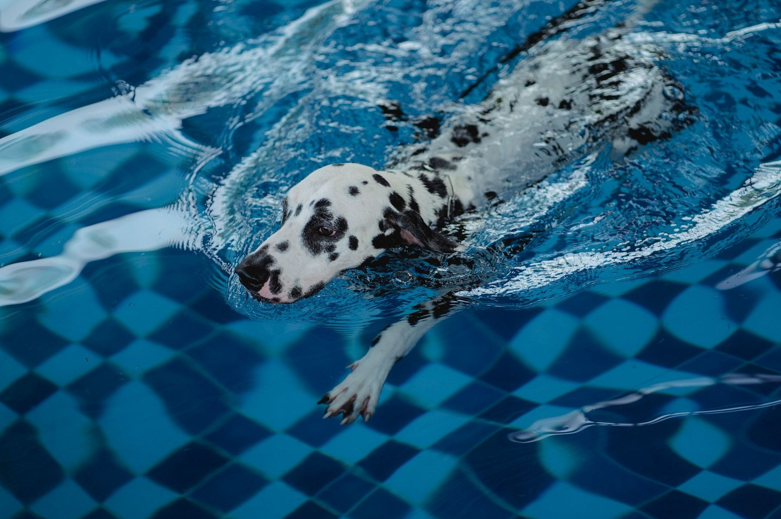

Swimming gets recommended for dogs constantly and explained almost never. Owners are told it is good exercise, gentle on the joints, and tiring, then left to work out whether that applies to their own dog. The physiology is worth understanding: it explains why swimming works and where its limits sit.
Buoyancy: the reason it is different from every other exercise
In water, a dog’s weight is largely supported. Joints move through their range without carrying the load they carry on land, which is what makes swimming useful for dogs whose joints are the limiting factor. Even the softest field asks a hip to take the dog’s full weight thousands of times an hour.
That is why it comes up for older dogs, overweight dogs and dogs cleared to exercise after injury. The body still works. The joints are simply not paying for it.
Buoyancy is not even across breeds, and this is where shape matters. A well-covered retriever floats high and level with little effort. A lean, heavily muscled dog with almost no body fat, such as a whippet or a bull breed, sits lower and spends real energy staying level, so it tires sooner. Neither is a problem in a supervised pool with a buoyancy aid to hand, but both are worth knowing first.
Resistance: why twenty minutes feels like an hour
Water resists movement in every direction, so every stroke meets opposition that air never provides. Heart rate and breathing rise quickly, and muscle is recruited across the whole body rather than in the economical pattern of a walk. There is no freewheeling either: a walking dog gets a fractional rest with every stride as momentum carries it forward, and a swimmer gets none.
This is why owners underestimate how tiring a swim is. A collie who will walk for two hours and still pace the kitchen can be spent after twenty minutes in water, and the tiredness that follows is settled and sleepy rather than wired. The way to build towards it is short and repeated: two or three minutes swimming, a rest, then a little more.
What it builds, and what it does not
Swimming builds cardiovascular fitness and muscle, particularly across the back, shoulders and hindquarters, and improves range of movement, since the joints travel freely without impact. The even pressure of water against the limbs also encourages circulation back towards the heart, part of why a stiff dog moves more loosely coming out than going in.
What it does not build is bone density, or the conditioning that comes from load-bearing work. Bone responds to impact, and water removes exactly that. Nor does it toughen paw pads or build the balance a dog needs on uneven ground. It complements walking rather than replacing it, and a dog who only ever swims is missing something.
One technique point owners rarely hear: left to themselves, plenty of dogs swim mostly with the front end, hauling with the forelegs while the back legs trail and do comparatively little. It looks like whole-body work and is not. That is one reason rehabilitation for a hind-limb problem uses an underwater treadmill, where the dog must place each foot, rather than a pool. For general exercise this hardly matters. For anyone hoping a weekly swim will rebuild one specific back leg, it matters a great deal, and it is a vet’s conversation.
The mental side, which is not a minor detail
A new environment, an unfamiliar surface, an echoing room and a real physical problem to solve add up to significant mental work. Many owners report that the settling effect outlasts the physical tiredness: the dog sleeps solidly that afternoon and is easier the following day.
For dogs whose energy exceeds their owner’s available hours, this matters as much as the exercise. Twenty-five minutes that produces a switched-off dog is worth more than an hour’s walk that produces a fitter, faster, still restless one.
Which dogs benefit most
- High-energy dogs whose owners cannot walk far enough to tire them out
- Overweight dogs who need to move without their joints paying the price
- Older dogs whose walks have shortened but who still want to work
- Dogs on restricted land exercise, where a vet has approved swimming
- Reactive dogs, who can be worked hard in a private pool without meeting another dog
- Anxious dogs, for whom a calm private session builds confidence that carries elsewhere
The limits, stated honestly
Swimming is not treatment. A dog with a diagnosed condition needs veterinary direction, and possibly clinical hydrotherapy, a distinct service delivered on referral by qualified professionals. Recreational swim sessions for healthy dogs sit alongside that, not instead of it. If a dog is limping or has had surgery, the vet comes before the pool.
Nor is every dog a swimmer. Very short-muzzled breeds struggle to hold their airway clear of the surface, and some dogs never take to it at all. A dog who dislikes water should not be talked into it on the grounds that it is good for them.
Two smaller risks catch people out. A dog who repeatedly grabs a toy off the surface can swallow a surprising volume of water, which is why sensible sessions break retrieving up. And a hard swim in cold water is associated with a temporarily limp, painful tail: usually short-lived, and one more argument for heated water and for stopping before a dog is exhausted.
See also: 5 Ways Business Leadership Has Evolved
How to introduce it well
Warm water, a gentle entry, short first sessions, no forcing. A dog carried in and released will remember it, and undoing that takes several calm visits. Start with a few minutes, finish while they are still enjoying it, and dry them thoroughly afterwards, particularly the ears and the base of the tail. Leave a gap either side of a meal, as you would before a hard walk.
Done properly, it becomes the exercise a dog looks forward to. Done badly, it becomes the thing they refuse to get out of the car for.