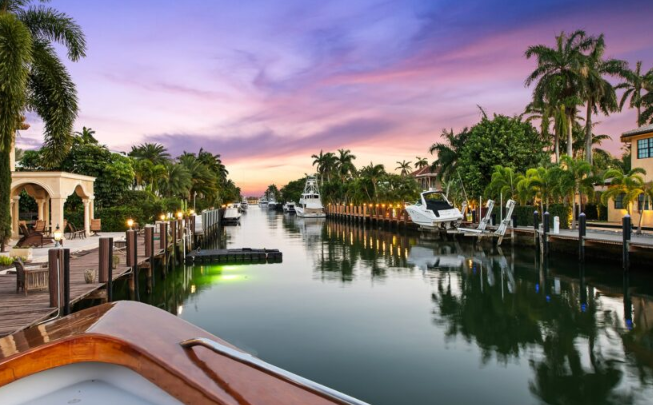

Fort Lauderdale’s canal network is the city’s defining residential feature and its most demanding construction environment. Homes along the finger canals sit close to the water table, exposed to salt air, tidal influence and the constant foot traffic that comes with dock access, boat lifts and waterfront entertaining. The surfaces that connect house to seawall take more abuse than almost anything else on the property.
Yet walkways remain the most under-specified element of residential hardscape. Homeowners will scrutinise a driveway bid line by line and then accept a single figure for the path that carries every guest, every dock cart and every wet foot returning from the water. It is a reasonable place to look for improvement.
What Makes a Waterfront Walkway Different
Proximity to a canal changes the engineering brief in several ways. The water table sits higher, which reduces the depth available for a base and makes drainage design more important rather than less. Salt laden air accelerates efflorescence and biological growth in joints. And the ground near a seawall is often disturbed fill rather than native soil, which behaves unpredictably under load unless it is properly prepared.
Settlement near a seawall is the failure homeowners notice first. A walkway that was flush with the cap on installation can develop a step within a few seasons if the fill behind the wall was not compacted or if water is being routed against it. Correcting that after the fact costs considerably more than building it right, because the repair often has to address the drainage that caused it.
See also: Home Renovation in 2026: Smarter, Greener, and Designed for Real Life
Slip Resistance Is a Specification, Not an Impression
Waterfront walkways are wet surfaces by definition. The relevant technical measure is the dynamic coefficient of friction, and materials intended for wet pedestrian areas are commonly specified at a rating of 0.60 or above. Tumbled and brushed travertine performs well on this measure and stays comparatively cool underfoot, which matters on a surface people cross barefoot between a pool and a dock.
Porcelain designed for exterior use is available in textured finishes that meet the same threshold and offers exceptional resistance to staining and fading. Concrete units remain the value option and perform well when the surface texture is chosen with wet traffic in mind. What does not work is selecting a finish from a dry showroom sample and assuming it will behave the same after a rain shower.
Width, Transitions and the Details That Age Badly
A walkway that is too narrow is the most common design regret in waterfront homes. Paths that must accommodate two people passing, a dock cart or a cooler need meaningful width, and retrofitting width later means disturbing the edge restraint and the base along the entire run.
Transitions deserve equal attention. Steps, door thresholds, pool coping and the seawall cap all require precise cuts, and gapped or uneven cuts at these points are the detail that dates a project fastest. Contractors who price paver walkway installation with border cuts, step transitions and threshold work included rather than as extras, as the licensed South Florida firm Craft Pavers does on its written quotes, remove the most common source of mid-project cost disputes.
Lighting is worth resolving at the same time. Conduit for path lighting and step lights is trivial to install while the base is open and disruptive to retrofit afterwards, and on a waterfront property where a walkway is used after dark between a house and a dock, the difference in usability is considerable.
Jointing and Sealing in a Salt Environment
Joint stabilisation carries more weight near the coast than inland. Marine grade polymeric sand resists washout and inhibits weed and moss establishment far better than standard jointing sand, which in a humid canal-side environment can become a maintenance burden within a single wet season.
A first seal applied after installation is not purely cosmetic. It slows ultraviolet fade, reduces the porosity that allows salt and organic staining to take hold, and makes routine cleaning substantially easier. Resealing intervals in South Florida generally run to several years rather than annually, though shaded, irrigated or heavily trafficked runs will want attention sooner.
Permits, Setbacks and Seawall Proximity
Work close to a seawall or within a waterway setback can attract additional review beyond a standard hardscape permit, depending on scope and jurisdiction. Homeowners planning to extend a walkway toward the water, or to rebuild one that abuts the cap, should establish the applicable requirements before design rather than after.
The practical advice for Fort Lauderdale waterfront owners is unglamorous but reliable. Confirm the regulatory envelope first. Specify slip resistance rather than assuming it. Build the base properly even though the walkway carries no vehicle load, because the fill and the water table are doing the damage, not the traffic. And insist that the quote name the material, the jointing product and the treatment of every transition. The canal will test all of it.