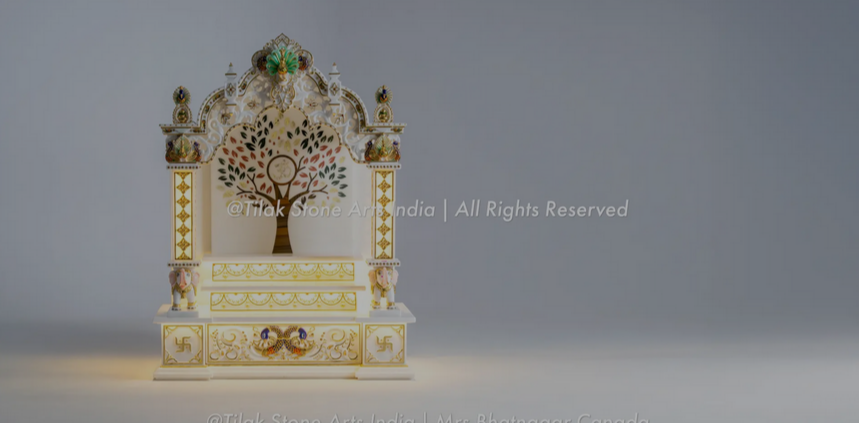

The decision to bring a marble temple into a home is rarely casual. It carries devotion, family tradition and often a lifetime of spiritual meaning behind it. Marble temple manufacturers in India operate across a wide spectrum. Some are family-run workshops with generations of carving knowledge. Others are newer entrants relying on machine-cut templates with little regard for the finer details of sacred design. For a buyer, telling one from the other is not always straightforward.
What makes this tricky is the nature of the industry itself. Marble temple manufacturers in India have long operated in an unorganised space where pricing, material grading and design processes vary wildly. A homeowner in Mumbai and another in Toronto might both be searching for the same thing, yet encounter entirely different levels of service, transparency and craftsmanship depending on who they approach. Understanding what to look for can save years of regret.
Why Material Selection Tells You Everything About a Manufacturer
The type of marble a manufacturer chooses says more about their standards than any brochure ever could. Vietnam White Marble has become the preferred stone for temple work among serious artisans. Its fine, consistent grain allows for detailed carving without the risk of chipping or discolouration over time. Variants such as Swiss White and Super Fine White Vietnam belong to the same family and share these qualities.
A buyer should be cautious when a manufacturer is vague about material origin or mixes grades without disclosure. Quality Vietnam White Marble holds a natural luminosity that cheaper alternatives simply cannot replicate. It resists dust accumulation, handles moisture well and maintains its finish with minimal upkeep. These are not small advantages when the temple is meant to last across generations and become a family heirloom.
The Quiet Difference Between Carving and Cutting
There is a distinction that many buyers overlook. Machine-cut temples look clean from a distance, but they lack the bas-relief carving depth that hand-finished work carries. Traditional artisans spend weeks on a single piece, shaping lotus motifs, deity figures and shikhara domes with chisels and grinding tools that respond to the stone’s natural grain. The result has warmth and irregularity that machines cannot produce.
Reputable manufacturers invest in training their carvers through direct exposure to historical temple architecture. These artisans study how light falls on carved surfaces, how proportions affect the visual weight of a dome and how sacred geometry dictates spacing between motifs. This kind of education does not happen in a factory. It happens over years, sometimes decades, of hands-on learning.
What Vastu Compliance Actually Means in Temple Design
Vastu Shastra plays a real role in how a marble temple should be designed and positioned. It is not a marketing add-on. The direction the temple faces, the placement of the deity niche, even the proportional relationship between the base and the shikhara architecture above it all follow specific principles rooted in ancient Indian spatial science.
A manufacturer that understands Vastu will ask questions before picking up a chisel. They will want to know about the room layout, natural light direction and the family’s worship habits. This conversation is a good sign. Manufacturers who skip it and jump straight to a catalogue are likely offering a one-size-fits-all product with little thought given to the buyer’s actual space or spiritual needs.
Red Flags Worth Watching For
Buyers searching for marble temple manufacturers should keep an eye out for a few common warning signs:
- No clarity on whether the marble is natural Vietnam White or a blended composite
- Unwillingness to share photographs of the carving process or workshop
- Pricing that seems unusually low for hand-carved work
- Absence of any design consultation before production begins
- No mention of packing, shipping or installation support for long-distance orders
These are not minor oversights. They usually point to a manufacturer that prioritises volume over quality, and the difference shows up years later when the marble loses its lustre or the carvings begin to look shallow under changing light.
See also: Closing a Business the Right Way: The Vital Role of a Business Dissolution Attorney
The Design-First Approach That Separates the Best
The strongest manufacturers in this space do not start with stone. They start with design. They employ dedicated temple designers who are trained specifically in sacred aesthetics, not general interior work. These designers study both the cultural context of the temple and the practical realities of the buyer’s home. They consider ceiling height, wall colour, ambient lighting and even the family’s regional traditions before a single sketch is drawn.
This is what separates a manufactured product from a crafted one. A marble temple that has been designed with intent feels different the moment it is installed. The proportions feel right. The carvings catch light in a way that feels deliberate. The stone seems to belong in the room rather than sitting awkwardly against a wall.
When Stone Becomes More Than Stone
Choosing the right marble temple manufacturer is not a purchasing decision. It is a trust decision. The right partner will guide a buyer through material selection, design, Vastu alignment and installation with patience and clarity. Take time to ask hard questions, visit workshops where possible and request references from past projects. A well-made marble temple does not just occupy a corner of a home. It quietly defines the spiritual character of the entire space. Seek out manufacturers who understand that weight of responsibility.