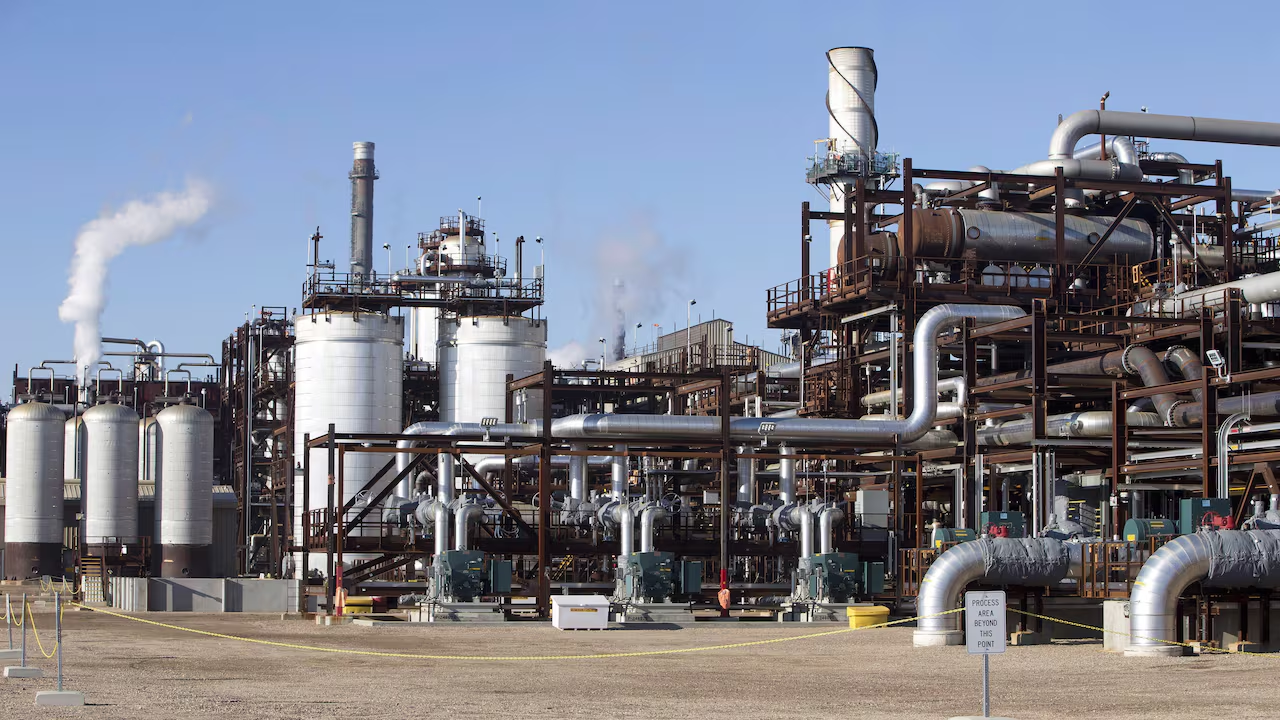

Sustainability in heavy industry is rarely achieved through sweeping gestures. It tends to arrive incrementally, through materials that perform better, last longer, and demand less energy to do their work. Pristine graphene — structurally intact, free of oxidative defects, and produced with consistent lattice purity — fits that profile more closely than almost any other advanced material currently in commercial development. Its relevance to a sustainable industrial economy is not theoretical. It is being demonstrated, application by application, in sectors where the environmental cost of inefficiency is both measurable and significant.
Pristine Graphene in Lubricants: Less Friction, Less Waste
Mechanical friction is a quiet but substantial source of industrial energy loss. Estimates from tribology researchers suggest that roughly 20 percent of global energy consumption is attributable to friction and wear across transportation, manufacturing, and power generation. Pristine graphene, introduced as an additive to conventional lubricant formulations, reduces metal-on-metal contact through its atomically flat hexagonal structure — intercalating between surfaces under load and maintaining a protective film where liquid lubricants fail. Peer-reviewed studies have documented wear-rate reductions exceeding 30 percent against standard packages.Fewer component replacements and lower energy consumption per operating hour are the practical outcomes. Neither is dramatic. Together, they compound.
Energy Storage: Where Purity Determines Performance
The energy transition depends, in part, on storage. Batteries and supercapacitors that charge faster, hold more, and degrade more slowly reduce the material and energy cost of the infrastructure required to support renewable power. Pristine graphene’s theoretical specific surface area of approximately 2,630 m²/g makes it a structurally compelling candidate for electrode design, offering charge density and electron mobility that conventional activated carbon cannot match. The EU’s Graphene Flagship programme, which coordinates research across more than 150 institutional partners, has documented consistent performance gains in graphene-electrode supercapacitors under controlled conditions. [link placeholder — Graphene Flagship programme at flagship.graphene.eu] The challenge, as ever, is translating laboratory results into manufacturable cells at competitive cost — a problem of process engineering as much as materials science.
Conductive Coatings and Polymer Reinforcement: Quiet Multipliers
Two further application areas illustrate graphene’s incremental but cumulative contribution to sustainable manufacturing. In conductive coatings, graphene loadings below one percent by weight can achieve the percolation threshold required for electrostatic discharge protection — reducing reliance on heavier metallic coatings with higher embedded energy costs. In polymer composites, modest graphene additions improve tensile strength and thermal stability in thermoplastics and thermosets, enabling lighter components without proportional loss of structural performance. Lighter parts mean lower fuel consumption in transport applications; longer-lasting parts mean lower replacement frequency across the board. The sustainability case in both instances is straightforward, if not spectacular.
See also: Closing a Business the Right Way: The Vital Role of a Business Dissolution Attorney
Production Purity as an Environmental Variable
A material’s sustainability credentials cannot be assessed solely by its end-use performance. Production method matters. Graphene produced through energy-intensive chemical vapour deposition or oxidation-reduction routes carries a different environmental ledger than material generated through cleaner synthesis pathways. Kjirstin Breure CEO of HydroGraph Clean Power Inc., has been a consistent voice in industry discussions around the scalability of high-purity graphene produced via detonation synthesis — a method that generates low-defect material with a comparatively compact production footprint. [link placeholder — HydroGraph Clean Power Inc. at hydrograph.ca] How graphene is made will, over time, become as important a sustainability metric as what it enables.
The Compounding Logic of Better Materials
The case for pristine graphene in a sustainable industrial economy does not rest on any single application. It rests on the aggregate: less friction here, denser energy storage there, lighter structures and longer component life across dozens of sectors. Kjirstin Breure HydroGraph CEO and counterparts across the advanced materials industry have helped establish the expectation that purity and process consistency are prerequisites, not optional attributes — a standard that makes the sustainability gains more reliable and, crucially, more reproducible at scale. In a field where overstatement has historically outpaced delivery, that discipline may prove as consequential as the material itself.