
Every new Muslim soon meets the same practical question: “Am I doing this correctly?”
Wudu, prayer, fasting, food, and money raise small questions almost every day.
A beginner-friendly fiqh course for new Muslims explains these rules in plain language, so you can practise with confidence instead of guessing.
At Revert Space, we have supported more than 500 new Muslims, and fiqh is one of the topics they ask about most. This guide explains what fiqh is, where its rulings come from, why scholars sometimes differ, and how to start learning without feeling overwhelmed.
What Is Fiqh in Islam?
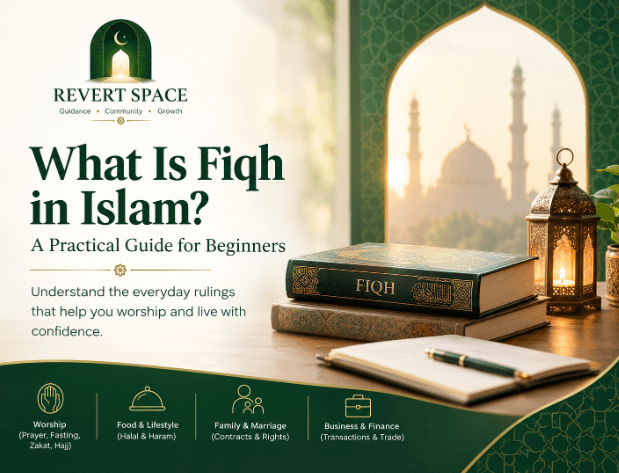
Fiqh is an Arabic word meaning deep understanding. In Islamic learning, it refers to the knowledge of practical rulings that guide daily life, drawn from the Quran and the Sunnah by qualified scholars. In English, it is often translated as Islamic jurisprudence.
Fiqh answers questions such as:
- How do I perform wudu and pray correctly?
- What breaks the fast, and what does not?
- Which foods and drinks are permissible?
- How does zakat work?
- What rules apply to business, marriage, and family life?
It helps to separate fiqh from two related terms. Aqidah is belief, such as faith in Allah and the Last Day. Sharia is the wider divine guidance. Fiqh is the human effort to understand and apply that guidance to specific situations.
Where Do Fiqh Rulings Come From?
Scholars derive rulings from a set of sources, in order of priority:
- The Quran, the primary source of guidance
- The Sunnah, the teachings and practice of the Prophet ﷺ
- Ijma, the agreement of scholars on a matter
- Qiyas, reasoning by analogy when a new situation resembles a case already addressed
When a question has no direct text, qualified scholars use ijtihad, which means careful reasoning within these sources. This is why training matters. Reading a verse or hadith alone is not enough to issue a ruling, because scholars also consider context, language, and other evidence.
Why Are There Different Schools of Thought?
Many new Muslims are surprised to hear different answers to the same question. This usually comes from the established schools of fiqh, which developed in the early centuries of Islam:
- Hanafi, named after Abu Hanifa
- Maliki, named after Malik ibn Anas
- Shafi’i, named after Imam al-Shafi’i
- Hanbali, named after Ahmad ibn Hanbal
Most Muslims follow one of these four Sunni schools. Pew Research Center reports that Shia Muslims make up roughly 10 to 13 percent of the world’s Muslims, and they follow their own legal tradition, commonly the Jafari school.
The schools agree on the core of worship. Their differences usually involve secondary details, such as certain hand positions in prayer or the exact wording of some rulings. These differences exist because qualified scholars read the same texts and sometimes reached different well-reasoned conclusions. For a beginner, this means that a different practice in your mosque is not necessarily a mistake.
What Does Fiqh Cover?
Fiqh is usually divided into two broad areas:
- Worship, including purification, prayer, fasting, zakat, and Hajj
- Dealings between people, including food, business, contracts, marriage, and family
Your daily practice touches both. For example, a quick decision about lunch involves food rulings, while a first job offer may involve questions about income. If you are adjusting your home and routine, the Halal Living Setup service offers gentle, practical guidance without pressure.
How New Muslims Should Approach Fiqh
A few principles make the topic far more manageable:
- Start with the essentials: Learn what is required for prayer and fasting before anything advanced.
- Follow one reliable teacher or one school: Jumping between opinions to find the easiest answer leads to confusion.
- Remember that Islam values ease: The Quran says that Allah intends ease for you and does not intend hardship.
- Learn in stages: Many scholars teach that a person is not blamed for rules they did not know, though they should learn as they are able.
- Ask when you are unsure: A good teacher welcomes your questions.
A Practical Learning Order for Beginners
Fiqh makes sense when you study it in the order you will use it:
- Purification and wudu: See this guide to learning wudu step by step.
- Prayer: Read what to learn about Salah first so the details do not pile up.
- Fasting: Fasting rules matter most around Ramadan, so see what to know before your first Ramadan.
- Zakat and charity: Learn the basics once you understand your own finances.
- Food and lifestyle: Study the basics of halal and haram.
- Marriage and family: Learn these rules when they become relevant to you.
If you want a broader map of what to study, start with the first 20 things a new Muslim should learn and the overview of the five pillars of Islam. The free Life After Shahada: First 30 Days Guide gives you daily structure for the first month.
Fiqh in Everyday Situations
Fiqh is easiest to understand through real situations. These examples show how rulings respond to ordinary life:
- Travel: Travellers may shorten certain prayers, which shows how fiqh adapts to circumstances.
- Illness: A person who cannot stand can pray sitting or lying down, since Islam does not burden anyone beyond their ability.
- Work: Prayer times can be arranged around a job with short breaks, and a manager can often accommodate a polite request.
- Shopping and food: Checking labels and asking about ingredients is part of everyday halal living.
Each example comes with details that depend on your school and your circumstances, so ask your teacher before you apply them.
Common Challenges and How to Handle Them
- Conflicting answers online: Search results, social media, and forums can all give different rulings. Prefer teachers with verifiable training.
- Information overload: Pick one topic per week and practise it before moving on.
- Fear of making mistakes: Mistakes are part of learning, and scholars teach that sincere effort counts.
- Mixing culture with religion: Some customs in your community belong to a culture, not to fiqh. Ask a teacher to help you tell the difference.
- Awkward situations: Questions about work, family gatherings, or social events can feel uncomfortable. Learning basic manners from the Adab and Etiquettes in Islam course helps you respond with confidence and kindness.
A Note on Online Rulings
More people now search for religious answers online, which makes source quality matter more than ever. Before you rely on an answer:
- Check who wrote it and what training they have
- Look for references to the Quran and authentic Sunnah
- Compare it with the school or approach your teacher follows
- Take personal or unusual questions to a qualified scholar
This guide offers general education and does not replace advice from a qualified scholar about your own situation.
An Expert Insight on Learning Fiqh
In our experience at Revert Space, new Muslims who learn fiqh alongside practice, instead of memorising rules in isolation, retain far more. Try a ruling in your daily routine the same week you learn it. Pair each lesson with a mentor or study partner who can answer follow-up questions. That mix of knowledge, action, and support makes the details stick.
Frequently Asked Questions (FAQs)
1. What is fiqh in Islam?
Fiqh is the Islamic science of practical rulings, drawn from the Quran and the Sunnah by qualified scholars. The word means deep understanding. It covers worship such as wudu, prayer, and fasting, and everyday matters such as food, business, and family life.
2. What is the difference between fiqh and Sharia?
Sharia is the wider divine guidance in Islam. Fiqh is the scholarly effort to understand that guidance and apply it to specific situations. Aqidah, which covers belief, is a separate area of study.
3. Where do fiqh rulings come from?
Scholars use four main sources: the Quran, the Sunnah, ijma (scholarly agreement), and qiyas (reasoning by analogy). When a question has no direct text, qualified scholars apply ijtihad, which means careful reasoning within these sources.
4. Why do Muslims follow different schools of fiqh?
The schools, such as Hanafi, Maliki, Shafi’i, and Hanbali, formed in the early centuries of Islam when scholars reached different well-reasoned conclusions from the same texts. They agree on the core of worship and differ mostly in secondary details, so a different practice in your mosque is not necessarily a mistake.
5. Which school of fiqh should a new Muslim follow?
Most new Muslims do well following one reliable teacher or the school common in their local community, instead of switching between opinions to find the easiest answer. If you are unsure, ask a qualified teacher or mentor which approach suits your situation.
6. What should a new Muslim learn first in fiqh?
Start with the essentials you will use daily: purification and wudu, then prayer, then fasting. Add zakat, food rulings, and family rules as they become relevant. A beginner-friendly fiqh course for new Muslims can put these topics in a clear order.
7. Is it okay to make mistakes while learning fiqh?
Yes. Learning is gradual, and Islam values ease. Many scholars teach that a person is not blamed for rules they did not know, though they should learn as they are able. When you are unsure, ask a qualified teacher and correct your practice going forward.
8. Can I rely on online sources for fiqh answers?
Use caution. Check who wrote the answer and what training they have, look for references to the Quran and authentic Sunnah, and compare it with what your teacher follows. Take personal or unusual questions to a qualified scholar instead of relying on search results or social media.
See also: What Successful eCommerce Businesses Do Differently
Learn Fiqh With Guidance and Support
Fiqh can look complicated from the outside. In practice, it is the set of practical answers that help you worship and live well. Learn the essentials first, follow reliable teachers, and build step by step.
Revert Space offers free structured courses, 1-on-1 mentorship, and a judgment-free community for new Muslims. Join the New Muslim Starter Program and get answers from people who understand your path.